Did you know a standard (pure-tone) hearing test cannot predict how well you hear in noise? It indicates how much a hearing aid may help you in less challenging places. However, most of us want to hear in noisy places too. There is other technology that helps in noise, such as remote microphones. Therefore, you should have speech-in-noise testing too.
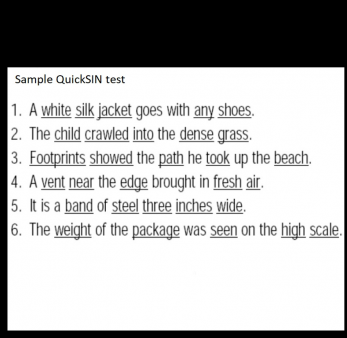
A speech-in-noise (SIN) test uses sentences played in various levels of background noise. Your score is based on how well you understand words at the different levels of noise. It determines how much louder the words need to be to comprehend them in relation to the level of noise. This comparison gives you a signal-to-noise (SNR) ratio. Hearing aids can improve SNR by 4-6 dB. Some people need more help than that so it’s important to know your score to find the right solutions and to set realistic expectations.
When you have speech in noise testing, be sure your hearing care professional uses pre-recorded speech. This ensures a more objective test. If they speak the words themselves, the volume or enunciation could vary and skew the results.
The hearWHO app from the World Health Organization tests your ability to comprehend numbers in noise. It is not a substitute for expert medical advice. However, it is a good example of trying to hear well in noise. It works on Android and iOS devices.
Some people with hearing loss benefit from a remote microphone or personal listening system that increases the intensity of speech in order to hear it over the noise.